MMD Sizer technology delivers smarter, low-carbon material processing
By admin September 1, 2026 5:37 pm IST
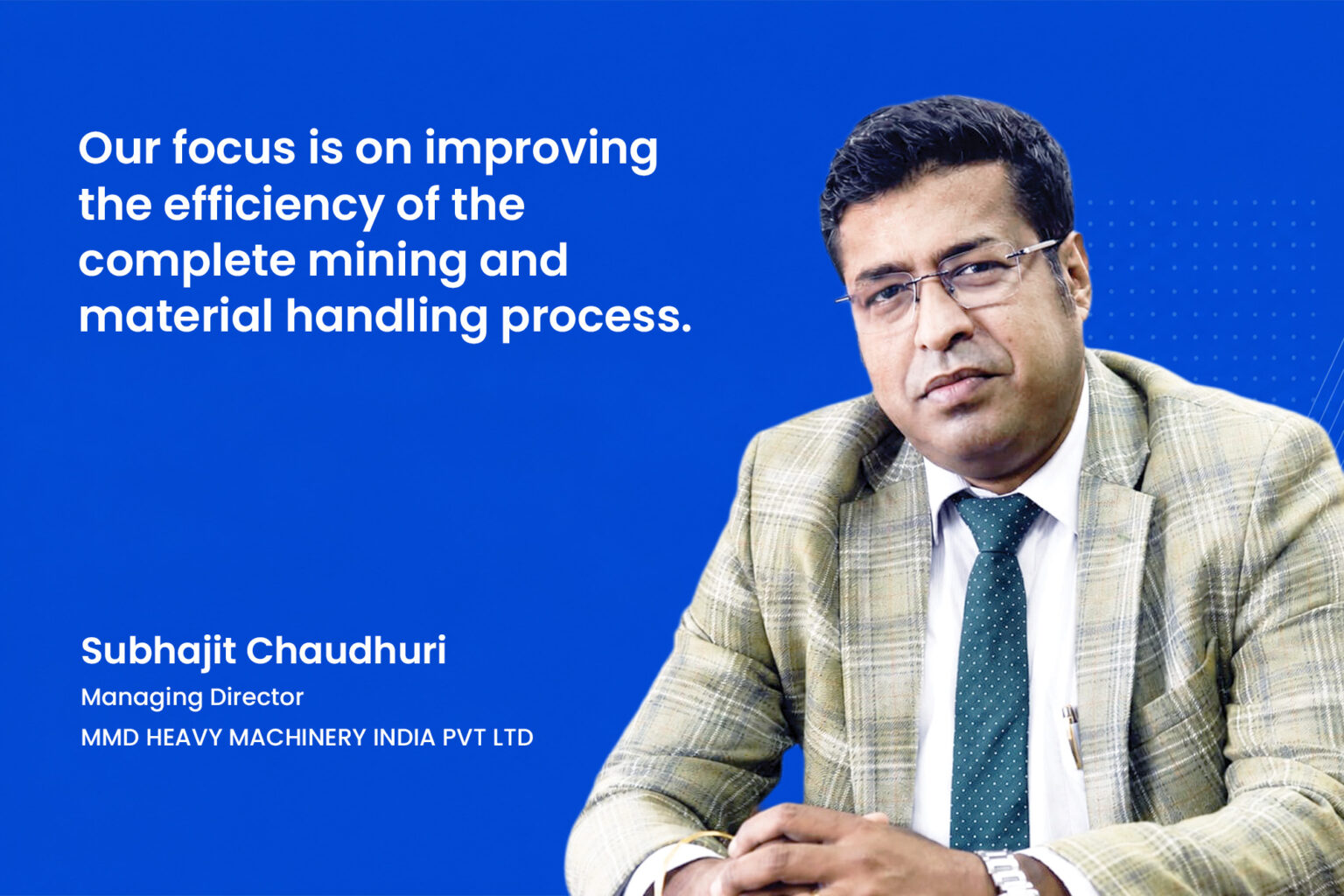
In this interaction, Subhajit Chaudhuri, Managing Director of MMD Heavy Machinery India Pvt. Ltd., discusses how application-specific Sizer technology and mobile material-processing systems are helping customers achieve higher productivity and more sustainable performance.
Matching a mobile crusher-screen train to variable, unpredictable feed material is one of the trickiest calls on site. How does MMD’s Sizer technology help?
Variable feed has always been one of the industry’s biggest operational challenges. Traditional crushing systems often struggle when materials become wet, sticky or highly heterogeneous, leading to blockages, excessive recirculation and inconsistent product quality.
This is precisely where MMD’s patented Mineral Sizer technology offers a fundamentally different approach.
Unlike conventional crushers, MMD Sizers employ a controlled combination of shear, tension, and bending forces. This enables the machine to exploit the material’s natural weaknesses rather than relying solely on compressive force. Initially, the material is gripped by the leading faces of opposed rotor teeth. These subject the rock to multiple-point loading, inducing stress into the material to exploit any natural weaknesses. In the second stage, the material is broken in tension by three-point loading applied between the front tooth faces of one rotor and the rear tooth faces of the other rotor. Any lumps of material that remain oversize are broken as the rotors chop through the fixed teeth of the breaker bar, thereby achieving a controlled, three-dimensional product size.
The result is several important operational advantages:
- Reliable handling of wet, sticky and mixed materials.
- Controlled three-dimensional product sizing with significantly reduced generation of fines.
- Due to the “rotating screen” effect, the undersized material passes through without further degradation or power usage.
Perhaps most importantly, every MMD Sizer is engineered around the customer’s material characteristics and operating conditions rather than being treated as an off-the-shelf machine. That application-specific engineering delivers consistent throughput even when feed conditions are less than ideal.
What is the single biggest shift you’re seeing in how organisations think about crushing-screening capacity, and what’s driving it?
The biggest shift is that customers are no longer purchasing crushing equipment simply based on installed capacity. Today, they are investing in operational flexibility and lifecycle productivity.
Infrastructure projects have become significantly more dynamic. Mine plans evolve faster, quarry faces change more frequently, and contractors are expected to mobilise rapidly while maintaining productivity from day one. As a result, customers increasingly seek solutions that can adapt to changing feed characteristics, relocate quickly, minimise civil works, and reduce total operating costs.
At MMD, we believe mobility is no longer just about transporting equipment; it is about creating an agile material-processing system. Whether through portable, semi-mobile or fully mobile sizing stations, our objective is to bring the crusher closer to the material, reduce unnecessary haulage, shorten commissioning time, and improve overall project economics.
Ultimately, procurement decisions today are driven less by the machine’s purchase price and more by cost per tonne, operational availability, energy efficiency, and the ability to respond quickly to changing site conditions.
Could you walk us through the trade-offs across primary, secondary and tertiary staging in a mobile circuit?
Every crushing circuit represents a balance between reduction ratio, product specification, energy efficiency and operating cost.
At the primary stage, the priority is accepting large run-of-mine or blasted material while maintaining reliable throughput. Robustness and availability are critical.
The secondary stage begins refining the product while maintaining production rates. Here, feed consistency becomes increasingly important, and the crusher must deliver controlled reduction without generating excessive fines.
The tertiary stage focuses on achieving the final product specification. Precision becomes more important than simply reducing size.
The advantage of a modular mobile system is that each stage can be configured to match the specific application rather than forcing every project into a standard flowsheet.
At MMD, we evaluate the complete material handling process-including feed characteristics, downstream conveying, plant layout and product requirements-to optimise the entire circuit rather than just an individual crusher. That systems approach often delivers greater productivity than simply installing larger equipment.
How do throughput, product gradation and wear-part life typically compare between mobile and fixed setups?
Historically, fixed plants offered advantages in very high-capacity applications, while mobile units were associated with flexibility. Today, however, that distinction has narrowed considerably.
Modern mobile and semi-mobile crushing systems can deliver very high production rates while offering significant operational flexibility.
From MMD’s perspective, the discussion should move beyond “mobile versus fixed” and instead focus on selecting the right solution for the mine plan and project life cycle.
In terms of performance:
- Throughput depends primarily on proper equipment selection and material characteristics rather than mobility itself.
- Controlled sizing technology delivers a consistent product with minimal fines, improving downstream processing efficiency.
- Because MMD Sizers only break oversized material and avoid unnecessary crushing, wear rates can be significantly reduced, leading to longer wear-part life and lower maintenance costs.
Equally important, mobile solutions often reduce truck haulage distances, lower fuel consumption and shorten relocation times, generating productivity gains that extend well beyond the crushing plant itself.

What’s next for crushing technology in terms of smart mobility and low-carbon performance?
The future is clearly moving towards intelligent, connected and energy-efficient material processing systems.
Customers increasingly expect equipment that not only crushes material efficiently but also provides continuous operational intelligence.
We see several major developments shaping the next generation of crushing technology:
- Greater integration of digital monitoring, predictive maintenance and remote diagnostics.
- Increased automation that enables plants to optimise performance in real time.
- Smarter material handling systems that reduce idle time and improve equipment utilisation.
- Electrification and reduced diesel dependency wherever practical.
- Closer integration between crushing, conveying and ore sorting to minimise unnecessary material movement.
At MMD, innovation has always extended beyond the crusher itself. Our focus is on improving the efficiency of the entire mining and material-handling process. Technologies such as fully mobile sizing systems, in-pit sizing and conveying, and intelligent material handling contribute to lower energy consumption, reduced emissions and improved overall sustainability.
The future is not simply mobile crushing; it is intelligent material processing.
What’s the single most important shift the crushing-screening industry must make to move faster, without compromising on quality, cost or sustainability?
The industry must shift its mindset from moving equipment to optimising the entire material flow. True productivity is not measured by how quickly a crusher operates, but by how efficiently material moves from the excavation face to the final product.
When equipment selection is based on total system efficiency- combining the right crushing technology with intelligent mobility, automation and integrated material handling- we achieve multiple benefits simultaneously:
- Higher productivity
- Lower energy consumption
- Reduced operating costs
- Improved safety
- Smaller environmental footprint
The future belongs to solutions that maximise value per tonne rather than simply tonnes per hour. At MMD, we believe innovation is not about building bigger machines — it is about building smarter, more efficient, and more sustainable material-processing solutions that enable our customers to meet the demands of tomorrow’s infrastructure while operating responsibly and competitively.