Go mobile
By admin September 1, 2026 4:49 pm IST
India’s dispersed projects and tighter capital economics are driving mobile crushing. But mobility pays only when equipment, geology, timelines and costs are aligned.
Is there a shortage of skilled labour? Go mobile. Are the sites dispersed among five states? Go mobile. Has owning a fixed plant become unappealing due to interest rates? Go mobile. In India’s mining and construction communities, this neat prescription is repeated so frequently that very few people take the time to consider what mobility truly solves for and, more importantly, what it doesn’t.
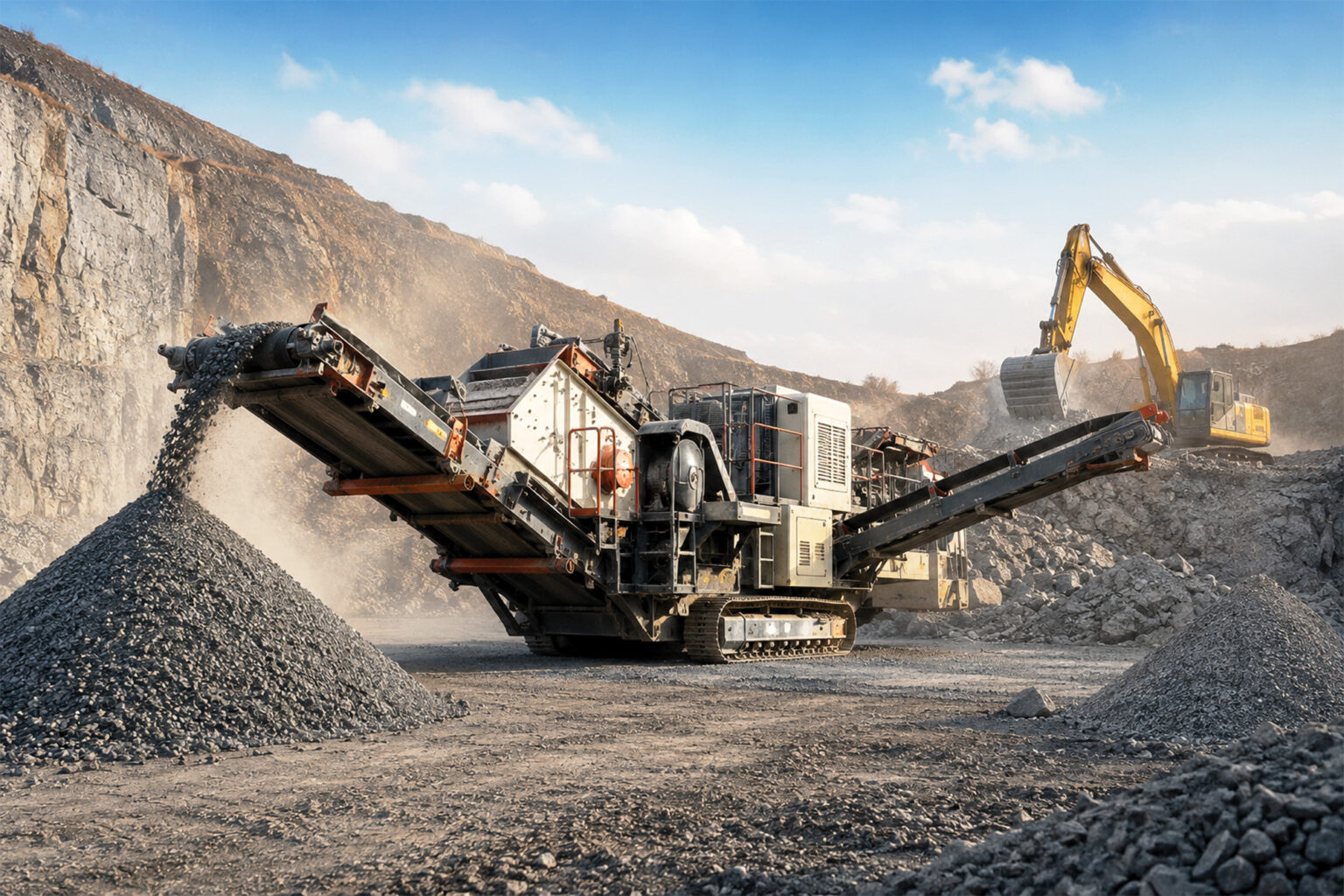
By itself, a crusher on tracks is not a productive tactic. It depreciates just as quickly as a stationary plant, but at a higher cost if you move it to the incorrect spot, feed it the wrong rock, or park it behind a contract with no penalty provision. The fact that the equipment travels is not what distinguishes the operations that truly benefit from movable and modular crusher screening capacity. The reason for this is that every aspect of the equipment, including its size, scheduling, contract, and waste stream, has been designed to move with it. It turns out that mobility is the easiest part.
A machine that reads the rock, not a spec sheet
Indian procurement has traditionally sized crushers based on installed capacity, assuming higher tonnage would follow. Ravisanth Pillai, who has commissioned units across various geologies, challenges this approach: “The project’s capacity and required output determine the crushing capacity. If you look worldwide, depending on the project, the capacity of mobile crushers will be 200 TPH and above — 200, 250, 300 TPH. Above 300 TPH, it is not as feasible for aggregate production; instead, it can be used for beneficiation, mineral ores, etc.” He adds that a two-stage 200 TPH track-mounted train usually draws 400–500 HP, matching actual project needs rather than providing excess headroom. Pushing harder leads to metal fatigue, and “if a machine runs for eight hours, it is advisable to rest the plant for one or two hours for cooling and inspection. Operating in this cycle can increase machine life.”
Subhajit Chaudhuri, Managing Director of MMD Heavy Machinery India, goes further, arguing that machines should adapt to the rock, not vice versa. MMD’s Sizer technology is designed to handle wet, sticky, heterogeneous feed using shear-and-tension breaking. “Customers are no longer purchasing crushing equipment simply based on installed capacity. Today, they are investing in operational flexibility and lifecycle productivity,” Chaudhuri says. “Mobility is no longer just about transporting equipment: it is about creating an agile material processing system… procurement decisions today are driven less by the purchase price of the machine and more by cost per tonne, operational availability, energy efficiency and the ability to respond quickly to changing site conditions.”
The currency nobody puts on a purchase order
If matching equipment is the engineering challenge, timing is the commercial one—and it’s often mispriced. JD Tripathi, experienced in costing across project stages, details foundation work: an excavator moves about 80 cubic metres daily at ₹15,000; reinforcement costs nearly ₹70,000 a tonne including labour; concrete work is ₹5,600–6,500 per cubic metre. “If we divide the project cost, there are two stages: direct and indirect costs,” Tripathi explains. “It depends on how much productivity you want in a day and the types of activities to be done, which must be defined. Based on the total cost per day, you can work out the complete project cost.”
Delays are more than scheduling issues—they become tangible losses when traced back to idle equipment like crushers. Mobilisation, once a logistical detail, is now a contractual discipline. Tripathi treats it as a checklist at project award, quickly releasing unneeded equipment to other jobs. Vibhav Joshi, who drafts bid documents for major projects, adds: “Timelines for deployment are defined, and penalties — temporary deductions, permanent penalties, liquidated damages — are enforced for delays,” with suppliers required to be close to the site to ensure efficiency.
The sand nobody wants to talk about
There is a third cost that rarely appears in a tender document at all: what a project leaves behind. India generates well over 100 million tonnes of construction and demolition waste annually, a number the Central Pollution Control Board expects to touch 165 million tonnes by 2030, and historically recycled almost none of it. That changes this year. The Environment (Construction and Demolition) Waste Management Rules, 2025, effective from April, require producers on projects above 20,000 square metres to register, file a waste plan, and hit recycled-content targets starting at 5 per cent from 2026-27 and climbing to 25 per cent for buildings by 2030-31.
Pillai reads the mandate as overdue rather than burdensome, tying it back to a resource he describes almost physiologically. “Natural sand is formed in rivers, which are like veins in our bodies, distributing water. Excess sediment and soil removal from rivers narrows banks, reduces capacity, and disturbs water balance,” he says. “Crushing rocks for construction prevents over-excavation from rivers… we are moving towards the triple R concept. Reduce, reuse, recycle.”
Joshi’s caution is the necessary counterweight. On projects funded by agencies such as JICA, he notes, environmental conditions are already strict. But recyclability still has to clear an engineering bar before it clears a compliance one. “Recycling is advisable if possible, but it depends on whether the excavated material is suitable for reuse,” he says. “There cannot be a generic answer. Specific situations require specific solutions.”
Owning less, deploying more
Financial factors are the final component of the mobility myth and are responsible for changing how equipment initially enters the market. Rental and hire-purchase arrangements for mobile fleets are getting real commercial traction due to high financing rates and project portfolios dispersed across several states. Shift dealers and OEMs in the crusher and screening industry, including local partners like Ashar Locker are already improving fleet sales and maintenance. The unit of comparison for buyers is no longer the machine’s sticker price; it is cost per tonne and guaranteed uptime, which is precisely the reframe Chaudhuri describes happening inside MMD’s own customer conversations.
It was never about the wheels
Which brings the story back to where it started. “True productivity is not measured by how quickly a crusher operates, but by how efficiently material moves from the excavation face to the final product,” Chaudhuri says. “The future belongs to solutions that maximise value per tonne rather than simply tonnes per hour.”
That is the sentence India’s procurement teams should be pinning above their tender templates. Mobility got the crushing screening industry’s attention because it is visible: tracks, hydraulics, a plant that can leave one site and reappear at another within days. But the projects actually winning on cost and schedule are the ones treating mobility as table stakes and competing instead on what happens around it: sizing the machine to the rock, pricing every idle hour, accounting for every tonne of waste, and buying uptime instead of steel. The crusher was always going to move. The industry that wins is the one that worked out, before everyone else, what to move it for.
Quotes:
“Modern mobile and semi-mobile crushing systems can deliver very high production rates while offering significant operational flexibility.”
– Subhajit Chaudhuri, Managing Director of MMD HEAVY MACHINERY INDIA PVT LTD.
“Screening performance is shaped as much by application engineering and material behaviour as by the screen itself.”
– Anubhav Chandra, National Sales Manager at Ashar Locker India Private Limited.
“M-sand is more than an alternative to river sand; it is a sustainable solution that reduces pressure on natural resources while delivering the graded material construction projects require.”
– Ravisanth R Pillai, Vice President – Sales & Marketing at Torsa Machines Limited.
“For linear infrastructure projects, mobile crushing can optimise resources, reduce logistics costs and keep projects moving efficiently.”
– Vibhav Joshi, Chief Operating Officer of PADECO.
“Every day of delay carries a cost. Effective mobilisation is critical to controlling project costs and keeping resources productive.”
JD Tripathi, Project Management Consultant at Global Aqua Treatment Technology Private Ltd.