India restricts lithium-ion battery black mass exports to boost domestic mineral recovery
By Staff Report 1 November 13, 2026 12:59 pm IST
The Directorate General of Foreign Trade has prohibited black mass exports to secure domestic recycling feedstock and strengthen critical mineral recovery.
The Directorate General of Foreign Trade (DGFT), under the Department of Commerce, has prohibited the export of lithium-ion battery black mass to strengthen domestic recycling capacity and improve the recovery of critical minerals.
The decision was notified through Notification No. 49/2026-27 dated 10 November 2026, which changed the export policy for the material under ITC (HS) Code 85491400 from ‘Free’ to ‘Prohibited’, with immediate effect and until further orders. Transitional arrangements under Para 1.05 of the Foreign Trade Policy (FTP), 2023, will apply.
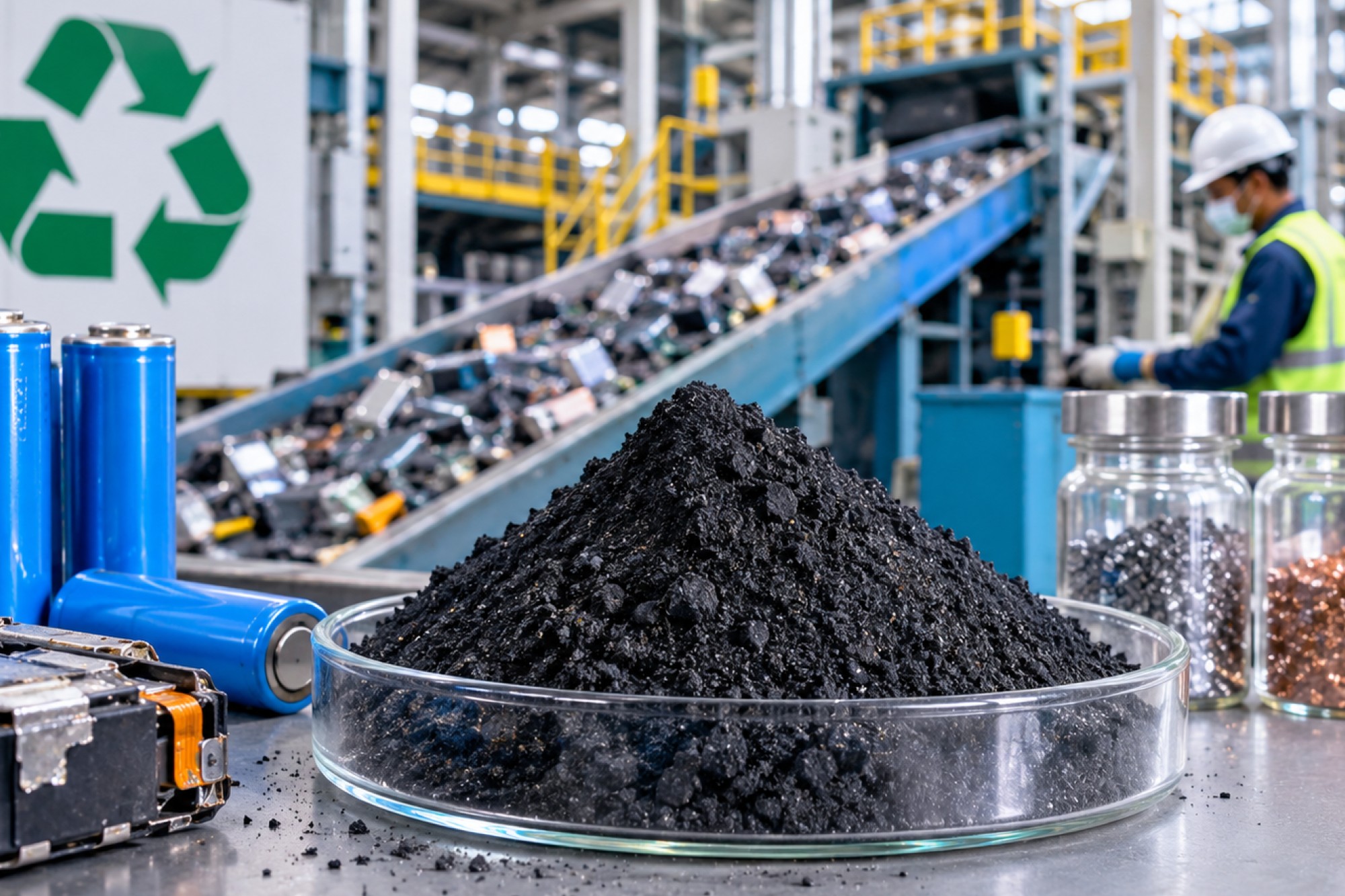
Black mass is the powdery material obtained by shredding end-of-life lithium-ion batteries and battery manufacturing waste. It contains recoverable quantities of critical minerals, including lithium, cobalt, nickel and manganese.
Focus on domestic recycling capacity
The government said the export restriction aims to ensure that black mass generated in India is recycled and refined within the country. Domestic recycling and refining facilities have faced inadequate feedstock availability, resulting in underutilisation of existing capacity. Some recyclers have also had to import material to meet their requirements.
Retaining black mass within the country is expected to improve feedstock availability, increase capacity utilisation and encourage further investment and employment in the recycling sector.
The measure is also expected to increase domestic recovery of lithium, cobalt, nickel and other critical minerals, reducing import dependence and associated foreign exchange expenditure.
Support for battery and clean energy supply chains
The restriction is intended to strengthen domestic supply chains for battery manufacturing, electric vehicles, energy storage and clean-energy technologies.
It also complements the National Critical Mineral Mission (NCMM) and the government’s ₹1,500 crore Incentive Scheme for Critical Mineral Recycling, approved by the Union Cabinet in September 2025. The scheme supports the development of recycling capacity for the separation and production of critical minerals from secondary sources, including battery waste and electronic waste.
The government said retaining black mass domestically would help ensure adequate feedstock for the recycling capacity being developed under the incentive scheme. The measure is also expected to support the circular economy and urban mining, while reducing reliance on primary mineral extraction.
Source: PIB